
Lok Sabha Seats May Rise from 543 to 816: How Women’s Reservation and Delimitation Could Reshape Indian Politics
- National
- (Asia/Kolkata)
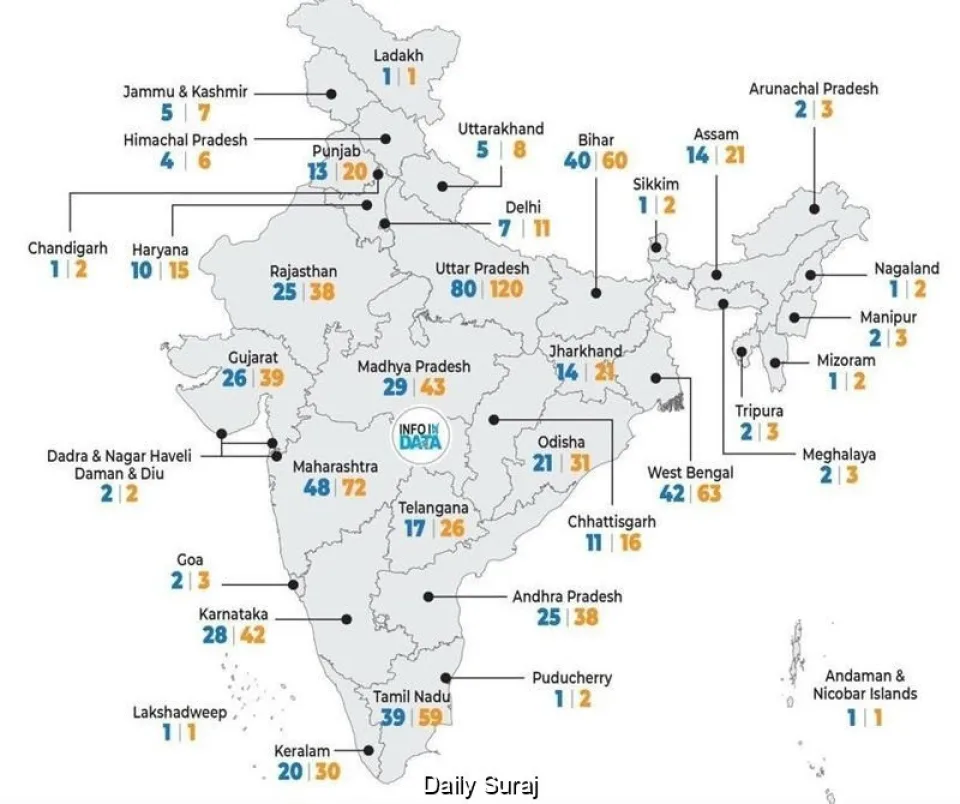
: India's parliamentary representation could undergo a major transformation, with the Centre proposing to increase the strength of the Lok Sabha from the existing 543 seats to 816. The proposed expansion is linked to the implementation of 33 per cent reservation for women in the Lok Sabha and state legislative assemblies, along with a fresh delimitation exercise.
The government aims to implement women's reservation before the 2029 Lok Sabha elections. Three bills related to women's reservation and delimitation are scheduled to be introduced in the Lok Sabha on Monday during a special session of Parliament. Question Hour and Zero Hour will not be held during the session.
Under the proposed plan, the number of seats in the Lok Sabha and state legislative assemblies could be increased by up to 50 per cent to facilitate the implementation of women's reservation. While the Lok Sabha's strength could rise from 543 to 816, another provision proposes setting the maximum membership at 850 for the Lok Sabha and 650 for state legislative assemblies.
Three Bills to Be Introduced in Parliament
The special session will see the introduction of three bills, including the Constitution (131st Amendment) Bill, 2026, and the Constitution (132nd Amendment) Bill, 2026.
The 131st Constitutional Amendment Bill will contain provisions relating to the formation of a Delimitation Commission. The 132nd Amendment Bill will provide for the redrawing of parliamentary constituency boundaries.
A separate bill will also be introduced to amend laws relating to Union Territories.
According to the Lok Sabha's listed business, Union Home Minister Amit Shah will propose the withdrawal of the existing Union Territories Laws (Amendment) Bill, 2026, and introduce a new bill in its place. Law Minister Arjun Ram Meghwal will introduce both Constitutional Amendment Bills.
One MP Currently Represents an Average of 27 Lakh People
The government maintains that the proposed delimitation exercise will strengthen democracy by improving representation for states in Parliament. It also aims to reinforce the constitutional principle of 'one person, one vote, one value'.
According to Law Minister Arjun Ram Meghwal, a Lok Sabha MP currently represents an average of around 27 lakh people, the highest figure among major democracies worldwide.
Following the proposed delimitation, this number is expected to come down to approximately 18 lakh people per MP. However, it would still be higher than the average of nearly 10 lakh people represented by each MP in 1971.
The government has also pointed out that 127 Lok Sabha constituencies currently have more than 20 lakh voters each. Representing such large populations and addressing their concerns has become increasingly challenging for individual MPs.
Meghwal said the existing 543 Lok Sabha seats were determined on the basis of the 1971 Census. Since then, India's population has grown to approximately 140 crore, while the number of Lok Sabha members has remained unchanged.
He also estimated that around 2.5 crore new voters could be added to the country's electoral rolls by 2029, making a fresh assessment of parliamentary representation necessary.
Southern States Also Expected to Benefit
The proposed delimitation exercise is expected to increase the parliamentary representation of five southern states: Tamil Nadu, Karnataka, Kerala, Telangana and Andhra Pradesh.
Their combined Lok Sabha seats could rise from the current 129 to 195.
Interestingly, these five states currently account for 23.76 per cent of the total strength of the 543-member Lok Sabha. Under the proposed 816-member House, their share is expected to increase slightly to 23.90 per cent.
The proposed changes have received support from several prominent political parties in southern India.
These include NDA allies Telugu Desam Party (TDP) and Jana Sena, as well as opposition parties such as the Dravida Munnetra Kazhagam (DMK), Bharat Rashtra Samithi (BRS) and YSR Congress Party (YSRCP).
Uttar Pradesh May Get 120 Lok Sabha Seats, Punjab 20
Under the proposed delimitation plan, the number of Lok Sabha seats across states could increase by up to 50 per cent. This would significantly change the distribution of parliamentary representation across the country.
The proposed changes in the number of Lok Sabha seats in major states and Union Territories are as follows:
State-Wise Proposed Lok Sabha Seat Increase
State/Union Territory Current Seats Proposed Seats
Uttar Pradesh 80 120
Rajasthan 25 38
Punjab 13 20
Haryana 10 15
Himachal Pradesh 4 6
Uttarakhand 5 8
Jammu and Kashmir 5 7
Ladakh 1 1
Chandigarh 1 2
Bihar 40 60
Jharkhand 14 21
West Bengal 42 63
Madhya Pradesh 29 43
Gujarat 26 39
Maharashtra 48 72
Odisha 21 31
Chhattisgarh 11 16
Goa 2 3
Karnataka 28 42
Andhra Pradesh 25 38
Tamil Nadu 39 59
Kerala 20 30
Telangana 17 26
A Major Change in India's Political Representation
If implemented, the proposed expansion of Parliament and the delimitation exercise could significantly reshape India's electoral and political landscape.
The increase in Lok Sabha seats would create more parliamentary constituencies and potentially reduce the population represented by each MP. At the same time, the proposed women's reservation would create greater opportunities for women to participate in legislative decision-making.
With the government targeting implementation before the 2029 general elections, the proposed bills are expected to become a major subject of political debate, particularly over constituency boundaries and the future distribution of parliamentary representation.


Leave a Reply