
Major Tax Fraud Networks Busted, 15 Arrested in Punjab Enforcement Drive
- Punjab
- (Asia/Kolkata)
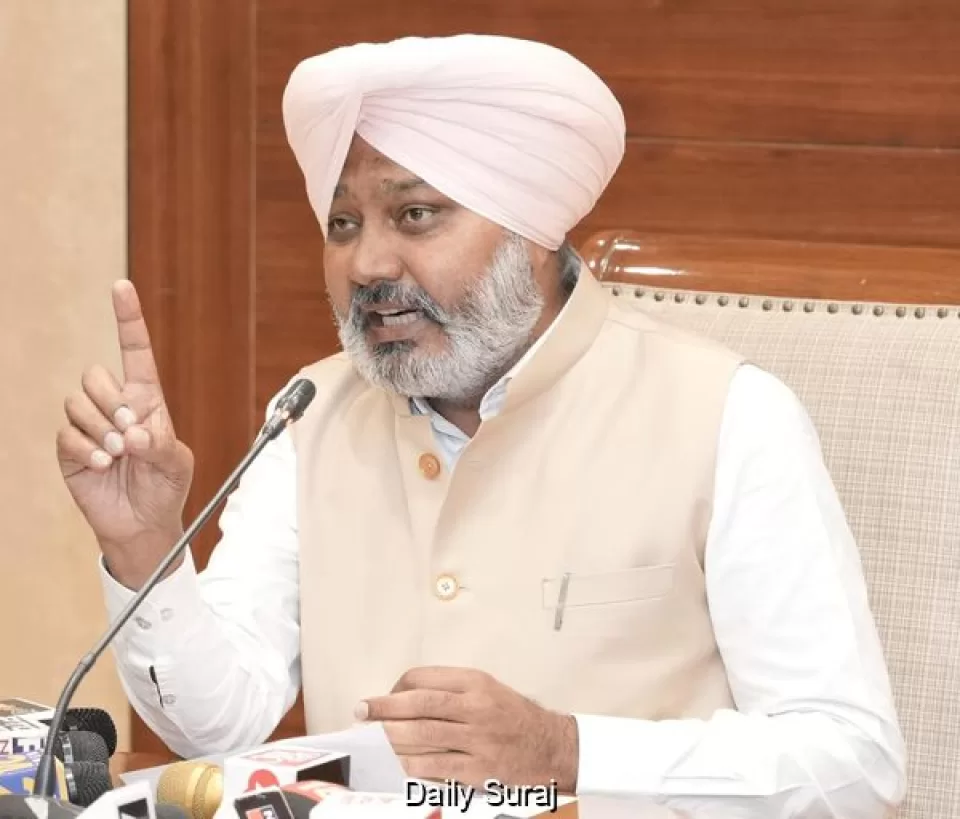
Reaffirming a zero-tolerance policy against tax evasion under the leadership of Chief Minister Bhagwant Singh Mann, Punjab Finance, Planning, Excise and Taxation Minister Harpal Singh Cheema on Monday announced that the state has achieved record enforcement outcomes during the financial year 2025–26. Providing details, the Finance Minister stated that focused and intelligence-based operations by State Intelligence and Preventive Units led to the imposition of penalties amounting to ₹1,383.11 crore. Out of this, ₹1,137.85 crore has already been recovered, marking a significant achievement in enforcement efficiency and revenue collection. He highlighted that inspection-based enforcement played a key role, contributing penalties of ₹1,215.95 crore and actual recoveries of ₹972.15 crore. Additionally, road-checking drives contributed ₹165.71 crore. The performance represents a substantial improvement compared to the financial year 2024–25, when inspection enforcement resulted in penalties of ₹147.28 crore and recoveries of ₹41.53 crore, while road-checking collections stood at ₹157.14 crore. Emphasising strict action against fraudulent networks, the minister said that eight FIRs were registered and 15 arrests were made during the year. Two major FIRs involving seven individuals exposed fraudulent transactions worth ₹385 crore. These targeted operations also uncovered tax evasion of ₹69.57 crore carried out through firms issuing invoices without actual supply of goods. Further action was taken against illegal transportation and bogus billing networks in Bathinda, Mandi Gobindgarh, Ludhiana and Chandigarh. In a significant case, a Ludhiana-based proprietor was arrested for passing fake input tax credit exceeding ₹9 crore. The minister also revealed that the department’s advanced intelligence network uncovered several major frauds, including fake billing of ₹900 crore in gold transactions in Ludhiana, ₹226 crore in illegal coal transactions across Mohali, Kharar and Kotkapura, and ₹423 crore in bogus billing networks operating in Ludhiana and Mandi Gobindgarh. Additionally, a ₹200 crore scam linked to the ‘Pet Pooja App’ was exposed during investigations, highlighting the scale and complexity of modern tax evasion networks. On verification drives, he said that 1,579 suspicious dealers were identified, out of which 922 entities were found non-existent after strict verification. Their registrations were subsequently cancelled in coordination with the central government. Highlighting ITC control measures, the minister stated that ₹244.82 crore was proactively blocked and ₹206.64 crore was recovered, resulting in total savings of ₹451.46 crore for the state, along with an additional ₹19.08 crore collected through direct cash recovery. He further noted that during a special enforcement drive conducted simultaneously in Mandi Gobindgarh and Ludhiana, a record 141 vehicles were seized in a single day. Enforcement efforts were also strengthened at railway stations and major transit points, with special focus on high-risk sectors such as iron and steel, cement, auto parts, tobacco and metals. Crediting institutional and technological advancements for the success, the minister said that the State Intelligence and Preventive Unit, Tax Intelligence Unit, and the ‘Bill Liyao Inaam Pao’ scheme played a crucial role. He added that modern data analytics, real-time e-way bill tracking, continuous intelligence gathering, and newly developed digital enforcement portals enabled faster and more coordinated ground-level action. Reiterating the government’s commitment, the Finance Minister said that the achievements of FY 2025–26 reflect a transformative shift towards intelligence-led enforcement. He emphasised that strict action will continue to dismantle fraudulent networks, promote honest business practices, protect genuine taxpayers, and safeguard the state’s revenue.






Leave a Reply